


Historically, South African housing stock has been – and remains – predominantly freehold. However, with space at a premium and a large, young population, the market is experiencing a shift towards sectional title homes, says Dr. Andrew Golding, chief executive of the Pam Golding Property group.
Dr. Golding, says: “Then post-hard lockdown, when work-from-home space and ‘room to breathe’ while isolating fuelled a growing demand for more spacious properties, this trend saw estates begin rising to prominence in the wake of the pandemic, with sales increasing from below 14% of total sales prior to Covid to around 17% by late-2021.
“Currently, a desire for security and a shift towards a lock-up-and-go lifestyle, coupled with changes in the way we view retirement, is seeing an uptick in interest and demand for homes in secure estates.
“While estate living was initially seen as the preserve of the wealthy, they are becoming increasingly accessible to a broader cross-section of home buyers as developers realise the potential of including sectional title and retirement homes in developments – thereby broadening the appeal of this convenient way of living.”
Meanwhile, Chris van der Merwe, Broker/Manager of RE/MAX Coastal, explains that there is an extreme demand for real estate along the Garden Route, from vacant land to high-end luxury homes. “Across all price ranges, we are experiencing a shortage of real estate. The demand outstrips the supply, which in time will, no doubt, affect prices,” he says.
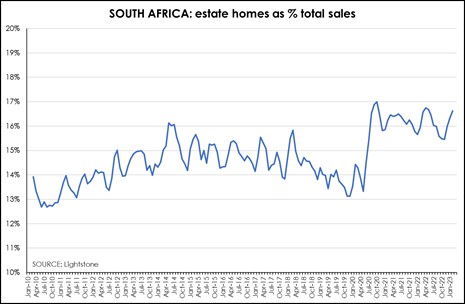
Sandra Gordon ,says research analyst for Pam Golding Properties: “In 2010, an estimated 13.1% of all properties sold in South Africa were located in estates. While this drifted higher in subsequent years, by 2019 an estimated 13.7% of all homes sold were in estates. However, this changed abruptly in the wake of the pandemic, rising to 15.4% in 2020 and remaining elevated. In 2022, 16.4% of all homes sold were in estates.
“Given the growing preference for the security and convenience of living in an estate, this trend is likely to continue during the year ahead – particularly as estates become more energy and water efficient – thereby widening their appeal – and as the variety of homes available for sale become more diverse, again expanding their desirability and making estate homes more accessible to a wider audience.”
Lightstone recently noted that estates make up just 7% of South Africa’s more than seven million registered residential properties, but account for 17% of the total market value. They estimate that there are currently around 440 000 properties in more than 5 000 estates across South Africa.
Lightstone also points out that while residential sales fell during the first year of the pandemic (2020), the subsequent recovery in sales was driven by both sectional schemes and estates.
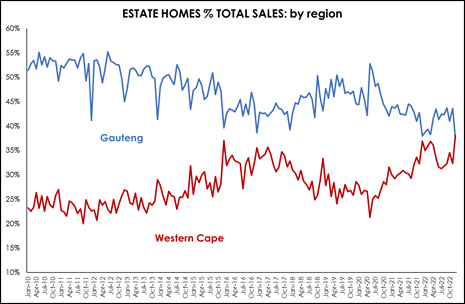
Dr. Golding says: “Statistics indicate that the Western Cape has become an increasingly important region in terms of estate sales, with the periods of growing estate sales in the region coinciding with the two periods of semigration – the first from 2013 to 2016 and the second from 2020 to date. This could reflect the preference of many buyers from Gauteng for estate living. As a result, the influx of older, more affluent home buyers from the rest of the country into the Western Cape during the current wave of semigration, could potentially result in a marked increase in estate sales.
Regional share of estate sales: (units sold)
| % estate sales | 2010 | 2019 | 2022 |
| Gauteng | 52.8 | 47.5 | 41.1 |
| Western Cape | 24.4 | 27.0 | 34.1 |
| KwaZulu-Natal | 6.3 | 5.9 | 5.8 |
| Eastern Cape | 3.4 | 4.3 | 4.6 |
“Lightstone indicates that the number of estates in the Western Cape is the fastest growing, followed by Gauteng and then KwaZulu-Natal. Gauteng and the Western Cape account for 70% of all estate properties (units) sold in South Africa. In fact, the two provinces have consistently accounted for over 70% of all estate sales since 2010, however, the composition has shifted, with the Western Cape accounting for a larger share of total estate sales.
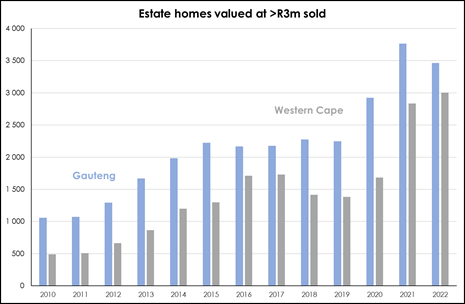
“While Gauteng is home to the largest number of homes in estates, the Western Cape has more high-value estate homes. In terms of actual sales, the shift in estate sales towards the Western Cape is the most noticeable in the R3 million+ price band. In 2010, Gauteng sold twice as many >R3 million estate homes than the Western Cape (1 060 vs 488) according to Lightstone. Sales in this price band increased steadily until 2015, when transactions concluded stabilised before rebounding once again in the wake of Covid. By 2022, Gauteng registered just 13.3% more >R3m estate homes than the Western Cape – highlighting the far stronger growth in the top end of the estate market in the Western Cape,” says Dr. Golding.
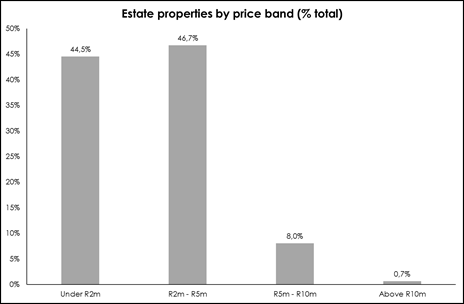
Gordon adds: “Lightstone notes that the estate market has ‘broadened’ during the past two decades. As a result, lower-value properties account for a sizeable portion of estate properties at the end of 2022. This was not the case when estates were first developed – when homes were almost exclusively larger, expensive freehold properties.
“Furthermore, Lightstone data reveals that at the end of 2022, nearly 190 000 estate properties were valued at less than R2 million, while 196 000 were valued at between R2 million and R5 million (chart below). Almost 35 000 were valued at more than R5 million.
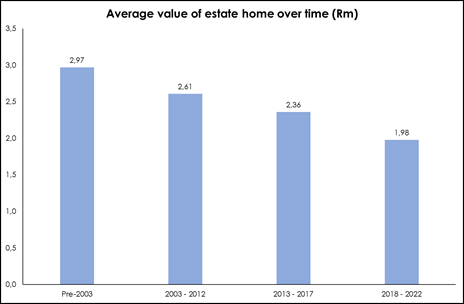
“To illustrate how the estate sector has become more diverse and affordable to a broader range of homebuyers, the graph below from Lightstone shows how the average estate property value has declined from nearly R3 million prior to 2003 to just under R2 million between 2018 and 2022.”
Investment opportunities along the Garden Route
Chris van der Merwe, Broker/Manager of RE/MAX Coastal, says the demand for coastal living has seen a sharp increase ever since the pandemic hit three years ago. Able to work more remotely, buyers continue to seek out a more relaxed, coastal lifestyle. Those who enter these markets before prices truly begin to climb are likely to find themselves enjoying some great returns on their investments.
“As things stand, there has already been a constant growth over the last 5 years; and, according to van der Merwe, following the pandemic, house prices have shown even stronger growth. “We have sold a house in Belvidere, Knysna in April 2022 for R7.9m and the same house has just been sold in May 2023 for R8.9m. This kind of growth tends to occur in certain hotspot suburbs that reflect higher growth rates, including Thesen Islands, Pezula Golf Estate, Belvidere, Eastford, Fernwood, and Simola Golf Estate,” he explains.
Investors who are looking to enter these markets early to enjoy greater returns should consider the newly built developments that are popping up in and around these markets. “The Sedge, situated in the heart of the Garden Route in Sedgefield, is a rare opportunity to own a piece of paradise at an affordable price. Prices for the one-bedroom units (starting at 46m2) start at R1,095,995 and the two-bedroom units (roughly 66m2) start at R1,439,995. Rental income for these units is projected to start from R8,500 to R14,500 p/m. These units are also solar powered, which means no loadshedding.”
“Another great option is Seahorse, a brand-new development situated in a quiet but central area of Knysna within a short stroll of the popular Knysna Waterfront and Thesen Island. Prices for these units start from R1.75m and range from 40m2 to 57m2, excluding terraces. To facilitate hassle-free Airbnb income, Perch Short Stays will offer a complete turnkey service on these units for investors, ranging from furnishing and marketing to management and maintenance.”
The great thing with these new developments is that buyers will also avoid having to pay transfer duties, which will save a buyer between R30,000 – R60,000 on transfer costs depending at which price point they’re purchasing.
“Another benefit of purchasing in one of these developments is that you can purchase now and take occupation at the end of 2024 – you just need to pay a holding deposit of 10% and the balance before registration. Taking building inflation into consideration, your purchase will already appreciate with 12 to 18 months while construction is underway – meaning your finished home will be worth more than you purchased it for,” van der Merwe comments.
These homes also stand to make good rental returns for investors. According to van der Merwe, there is a strong demand from younger professionals and retirees who have scaled down – “so much so that our rental department fills the properties before they can even be advertised. On a long-term lease, the returns are not as profitable as they are in the bigger metros due to the fact that we are a tourist destination. However, short-term letting is extremely profitable in our markets. Letting a 1-bedroom or 2-bedroom apartment close to the Knysna Waterfront can fetch a landlord between R1,200 and R2,600 per night in high season. A typical 4-bedroom house on Thesen Islands could generate between R5,000 to R6,500 per night,” he explains.
He also notes that demand in these areas is unlikely to be affected by the interest rate hikes. “As things stand, we have not experienced any downturn in our sales volume due to the interest rate hikes as our roughly 80% our transactions come from cash buyers and the remaining 20% make use of mortgage loans. This is probably because most of our buyers are selling their homes in other provinces and semigrating from Gauteng, EC, KZN, and Cape Town to the Garden Route. We have also seen the return of foreigners to our area after the pandemic, as the exchange rate is extremely favourable for them at the moment. We have recently sold to German, Swiss, and UK buyers.”
“The Garden Route is such an investment hotspot at the moment. Those who get in early stand to make such great returns on their investments,” he says.
Recent Comments